
FLAGSHIP SERVICE · AI BUSINESS AUTOMATION
AI business automation that connects your operations
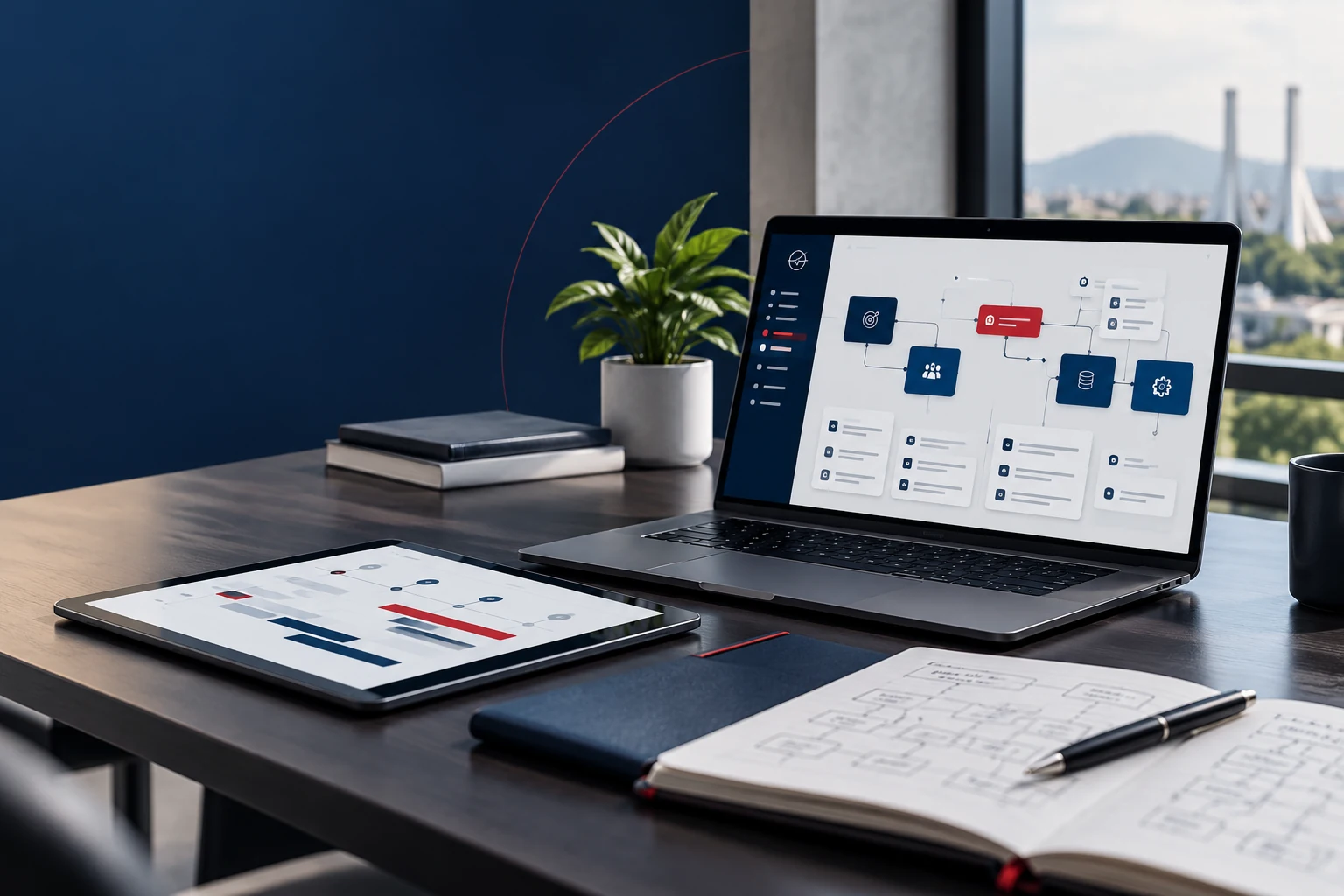
Lumiverse helps businesses and organisations turn disconnected tasks into practical, controlled workflows. Our business automation services connect the people, information and tools behind enquiries, approvals, documents and day-to-day operations.
From our Abuja headquarters, we work with local and international teams to scope AI automation solutions around real processes, existing systems and clear responsibilities.
BUSINESS VALUE
Less manual coordination. More control over the work.
Automation is useful when it removes a specific operational burden. We start with the handoffs, repeated inputs and decisions that slow a process down, then agree what should change and how the team will judge it.
Reduce repeated handling
Move agreed information between tools without asking people to re-enter the same details at every step. Keep validation and exception handling part of the workflow.
Keep records connected
Link enquiries, customer records, documents and tasks so each stage has the information it needs. Define which system owns the record before connecting it.
Make exceptions visible
Route incomplete inputs, failed actions and decisions needing judgement to a named person. A workflow should make responsibility clearer, rather than hide work in the background.
Create a testable scope
Agree the starting point, expected actions and acceptance checks. Assess the workflow against those requirements before extending it to more teams or processes.
AUTOMATION CAPABILITIES
AI and workflow automation services, shaped around your systems.
An engagement can focus on one process or connect several related workflows. The tools and level of automation follow the task, the available integrations and the sensitivity of the information involved.
Intelligent workflow automation
Map triggers, rules, approvals and follow-up actions across a business process. Route requests, update records and send agreed notifications, with clear handling for missing information and failed steps.
AI assistants and agents
Scope AI agents for business tasks such as enquiry triage, knowledge retrieval, classification and draft preparation. Define the information they can use, the actions they may take and when a person must review or approve an output.
CRM and sales workflow automation
Connect lead capture to the CRM, assign ownership and create agreed follow-up tasks. CRM automation can support consistent record updates without treating every new contact as a qualified lead or sending uncontrolled messages.
Document and data automation
Extract, classify and route information from supported documents and forms. Build checks for incomplete records, ambiguous inputs and review requirements before information is committed to another system.
Business systems integration
Connect websites, business applications, databases and supported APIs. Document field mappings, authentication requirements, rate limits and retry behaviour so integrations are understandable and maintainable.
Monitoring and ongoing improvement
Agree which events to log, who receives failure alerts and how changes are approved. Review the workflow after implementation and adjust the agreed scope as tools, volumes or operating procedures change.
A PRACTICAL STARTING POINT
Automate the right process, not every process.
A focused workflow assessment helps distinguish work that is ready for automation from work that needs clearer rules first. We look at the process as it actually operates, including the exceptions people currently resolve.
The same information is copied between forms, spreadsheets or applications.
Requests wait because ownership or the next action is unclear.
Teams repeatedly prepare similar documents or internal updates.
Approvals and follow-ups depend on someone remembering each step.
Existing tools have useful data but do not share it reliably.
A previous automation needs clearer monitoring or operational ownership.
Predictable tasks often suit rules-based process automation. We use AI where a defined task benefits from interpretation or generation and suitable review is possible. A pilot may be the right first step; a fully autonomous system is not the default.

WORKFLOW APPLICATIONS
Start with a workflow your team recognises.
These are example engagement areas, not claims about completed client deployments. Each requires a review of your systems, permissions, data and working practices.
Enquiry to an owned follow-up
Capture an enquiry, check the required details, create or update a CRM record and assign the next task. Keep human qualification and communication rules explicit.
Document to a reviewed record
Receive a supported document, extract relevant fields, flag uncertainty and send the result for review. Move approved information into the agreed operational system.
Operational activity to a useful update
Bring agreed records together for a scheduled internal summary or exception report. Identify missing inputs and keep source information traceable rather than presenting an unsupported conclusion.
OUR DELIVERY PROCESS
From workflow discovery to a controlled handover.
AI workflow solutions need more than a working demonstration. We plan the operating model alongside the integration, including how people review results and recover when a step fails.
01
Discover and map
Review the current process, users, tools and data flows. Identify repeated work, exceptions and the business outcome the engagement should support.
02
Design the workflow
Define triggers, mappings, decision rules and human checkpoints. Assess connector/API availability, access requirements and any third-party service costs.
03
Build and integrate
Implement the agreed workflow in suitable tools, such as n8n, Zapier, APIs or approved AI services. Keep configuration and responsibilities documented.
04
Test and pilot
Check normal, incomplete, duplicate and failure scenarios. Use an agreed pilot to review behaviour with the team before any wider operational rollout.
05
Handover and optimise
Document ownership, access, monitoring and rollback. Agree whether ongoing maintenance, usage reviews or further workflow changes are included or separately scoped.
GOVERNANCE & OPERATIONAL CONTROL
Keep people accountable, even when tasks run automatically.
The level of control should match the consequences of the task. We agree where the workflow can act, where it should pause and who can change its behaviour. No automation is presented as a substitute for appropriate business judgement.
Human review
Identify outputs and actions that need approval, with an escalation path for uncertainty.
Scoped access
Use permissions appropriate to the integration and define who manages accounts and credentials.
Failure handling
Plan retries, duplicate protection and recovery steps for supported integrations.
Data handling
Review what information is necessary, where it moves and the retention requirements to be addressed.
Operational documentation
Record workflow logic, system dependencies, monitoring and rollback responsibilities.
Support boundaries
Separate implementation, third-party subscriptions and ongoing support so ownership and cost are clear.
CONNECTED DIGITAL SOLUTIONS
Automation works best with sound engineering around it.
A workflow may need a better data model, a website integration or a broader technology decision. We connect the relevant services without replacing the tools or processes that already work.
Custom Software Development
Build the application logic, interfaces or integrations a packaged connector cannot provide.
Explore Custom Software Development
Technology Consulting
Clarify priorities, platform choices and the automation roadmap before committing to implementation.
Explore Technology Consulting
Website Maintenance
Agree ongoing technical care for website components that support the workflow.
Explore Website Maintenance
Where a workflow starts with a website enquiry, align it with your website design and SEO strategy. Discovery, successful submission and qualified-lead follow-up are different stages.
RELEVANT ENGINEERING EXPERIENCE
Business rules that connect a storefront to real operations.
The Meenat Muslimart case study documents a WooCommerce platform with bespoke shipping calculations, delivery-coverage checks and catalogue restructuring. It is relevant evidence of connecting customer-facing journeys with operational rules.
This is a documented commerce and software project, not a claim that we deployed an AI agent for the client.

WooCommerce · Custom shipping logic · Mobile experience
Meenat Muslimart
Explore the documented store, delivery and fulfilment scope, including where custom software supported the operating process.
Read the case study →
FREQUENTLY ASKED QUESTIONS
Questions before you automate.
Do we need AI for every automation?
No. Rules-based workflow automation often suits predictable inputs and actions. We consider AI where interpretation, retrieval or drafting has a clear role, and define suitable checks. The assessment should justify the tool rather than begin with an assumption that AI is required.
Can you work with our existing CRM and business software?
We first assess supported connectors, APIs, access permissions and data formats. Some tools connect directly; others may need custom integration or a narrower scope. We confirm feasibility and dependencies before promising that a particular platform can be automated.
How much control can an AI assistant have?
That is part of the scope. An assistant might suggest a response, prepare a draft or classify a request while a person approves the action. More consequential actions need appropriate permissions, checks and recovery arrangements; unrestricted autonomy is not assumed.
What should we prepare for an automation assessment?
Bring a description of one process, the people involved, the tools used and examples of common exceptions. Sanitised sample inputs and an explanation of the desired outcome help us define the workflow without unnecessary access to sensitive information.
How do you approach sensitive business information?
We review which data the workflow needs, the systems it will reach and the access and retention requirements to address. Third-party AI or automation services require their own suitability review. We do not promise blanket legal compliance or assume that all information should be sent to an AI model.
What affects the cost and delivery scope?
The number of systems, connector availability, data quality, decision rules, testing requirements and support arrangements all matter. Third-party subscriptions or usage charges may be separate. We propose a defined scope rather than promise a standard price or timeline for every workflow.
Who owns the accounts and ongoing operation?
We agree account ownership, administrator access and handover responsibilities before implementation. Documentation should explain dependencies and who monitors the workflow. Any ongoing managed support or further optimisation is identified in the engagement scope.
Can you support teams outside Nigeria?
Yes. Lumiverse is headquartered in Abuja and offers remote delivery for suitable local and international engagements. We agree communication, access, stakeholder availability and handover arrangements around the project rather than assume an on-site delivery model.
START WITH ONE WORKFLOW
Tell us where the work gets stuck.
Share the process, the tools involved and what you want to improve. We will help define a practical starting point, the decisions people need to retain and the scope of an automation assessment or implementation.